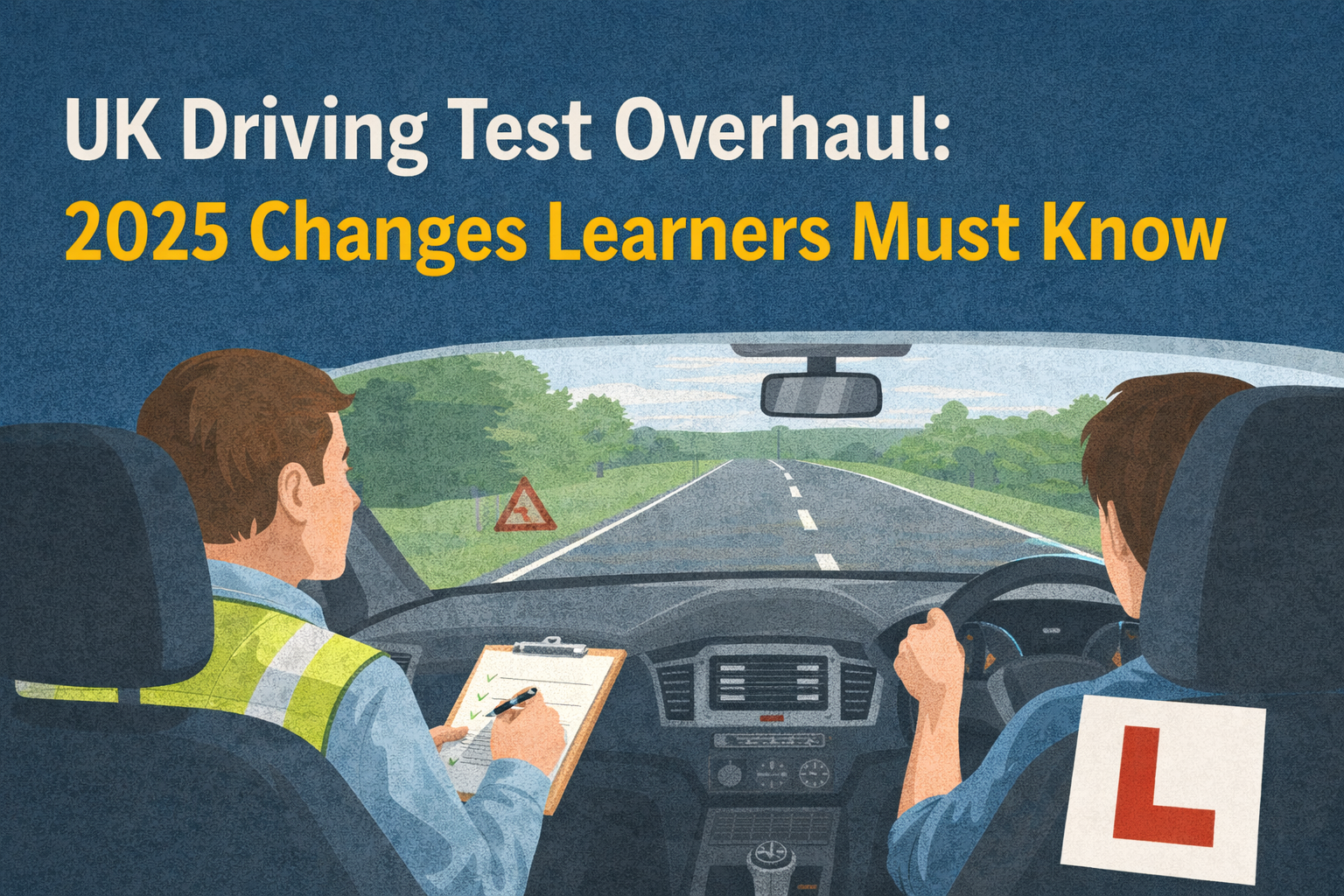
If you’re currently learning to drive or planning to sit your practical exam soon, you’ve probably heard the buzz about the UK driving test getting a major update. These changes, which came into effect on 24 November 2025, aren’t just small tweaks. They’re designed to make the test more reflective of real‑world driving and to prepare safer, more confident drivers for modern roads.
In this blog, we’ll walk you through what’s changed, why it matters, and how it could affect your preparation. The aim of the Driving Test Overhaul isn’t to make the test easier or harder, it’s to make it better aligned with the skills you’ll need every day behind the wheel.
1. Key Changes Explained
Three major revisions now shape the structure of the UK driving test, as confirmed by the DVSA:
Fewer Routine Stops
In the past, learners were typically asked to perform four ‘normal’ stops pulling up at the kerb and moving off again during a test. Under the new format, this has been reduced to three stops. This change allows test routes to include a broader range of road types, especially faster and rural roads, which demand more dynamic driving skills.
Changes to the Emergency Stop Exercise
Previously, the emergency stop manoeuvre appeared in roughly one out of every three tests. From November 2025, that frequency drops to around one in seven tests. This revision acknowledges modern safety technology like anti‑lock braking systems (ABS) that are now standard in most vehicles.
Extended Independent Driving
Perhaps the most noticeable shift is in the independent driving segment. Rather than sticking to a fixed 20‑minute instruction phase, candidates may now follow sat nav or road signs for much of the test, or even the entire duration, giving examiners more insight into how you navigate decisions on your own.
These updates change how the assessment feels on the day, which is more natural, more relevant to everyday driving, and more varied in route planning. It’s helpful to remember that while the format is evolving, the core expectation of safe, competent vehicle control remains the same.
2. Benefits for Learners
You might be wondering, “What do these changes mean for me?” The overhaul brings several advantages:
A More Natural Driving Experience
With fewer artificial stops and longer sections on open roads, the test feels more like everyday driving. This can help reduce test‑day anxiety and give learners a chance to show competence in a more realistic setting rather than just in controlled environments.
Exposure to Real‑World Scenarios
By spending more time on higher‑speed and rural roads, learners get a chance to demonstrate hazard perception and decision‑making skills that reflect real journeys outside urban practise areas. That’s a win for risk awareness and long‑term safety.
Greater Independent Driving Opportunities
Extending the independent driving segment means you’ll get more time following directions, reading traffic signs, and using navigation tools. All skills you’ll rely on once you’re licensed and driving solo.
Overall, these changes help level the UK driving test experience closer to what real, everyday drivers encounter on British roads.
3. Examiner Insights
Examiners involved in the trials of this revised format have shared positive feedback. They note that the updated structure allows candidates more opportunities to demonstrate decision‑making, observation, and awareness over a wider variety of conditions than before.
One of the chief motivations behind the overhaul is to improve road safety. Data shows that young drivers are disproportionately involved in serious and fatal collisions on faster rural routes. Nearly half of all serious casualties among novice drivers occur outside town centers. Testing that exposes learners to these conditions helps ensure new drivers aren’t just good at manoeuvres, but good at handling real challenges too.
Examiners have also welcomed the reduced emphasis on routine stops, saying it streamlines the test and lets them focus on higher‑risk, higher‑reward driving behaviours like lane discipline, hazard awareness, and independent navigation.
4. Implications for the Public
What does this mean for UK roads? For one, new drivers are likely to be better prepared for the actual driving environments they’ll face after passing their test. From busy dual carriageways to unpredictable rural roads, the test now encourages learners to demonstrate skills that matter beyond the test center.
This update comes amid broader efforts to tackle the UK driving test backlog and improve overall driver preparedness. Measures like increasing examiner recruitment, introducing tougher booking rules, and banning bots or third‑party resellers are also being implemented to help learners secure test slots more fairly and efficiently.
Better‑prepared drivers ultimately contribute to safer roads for everyone, reducing the likelihood of accidents caused by inadequate observation or unfamiliarity with varied driving scenarios.
5. Changes to Booking and Test Fraud
It’s not only the test format that’s getting a shake‑up. The government and DVSA have published measures to make the booking system more transparent and fair. These include new notices requiring longer lead times for test changes, learners must now give 10 full working days’ notice to change or cancel without losing a test fee.
Additionally, reforms are underway to prevent abusive practices like bots and third‑party reselling platforms snapping up test slots and selling them at inflated prices. The intent is to make sure real learners get access to tests at fair prices, while cracking down on those who exploit high demand for profit.
These booking system tweaks don’t directly affect how the UK driving test is marked, but they can reduce unfair barriers to getting a test date, an important part of a learner’s journey.
6. How to Prepare for the New Test Format
While the structure has changed, the skills you need to pass the UK driving test haven’t disappeared. They’ve just been given a broader stage. Here’s how to prepare:
-
Practice on a Variety of Roads
If you only ever practise in quiet residential areas, broaden your training to include busy B‑roads, rural routes, and faster sections of road. -
Build Strong Independent Driving Skills
With the new independence section potentially lasting the whole test, being comfortable reading a sat nav and reacting safely to signs is more important than ever. -
Stay Confident with Emergency Procedures
Even though emergency stops are less frequent, you should still practise them — the last thing you want is to encounter one for the first time during an exam. -
Lesson Variety
Ask your instructor to take you on diverse routes and simulate longer independent driving stints to build familiarity with what the new test expects.
Preparation may feel more challenging under the updated format, but it’s ultimately a chance to hone real‑life driving skills that matter beyond a pass certificate.
Conclusion: Moving Forward with Confidence
The UK driving test updates that rolled out in November 2025 signal a shift toward testing that’s more reflective of everyday driving conditions. Rather than being an artificial milestone, the test is now better structured to assess how well learners can handle modern roads during real journeys.
The Driving Test Overhaul brings notable changes like fewer stops, less frequent emergency stops, and longer independent driving. The core skills required remain rooted in safety, awareness, and confidence. If you approach your training with a mindset focused on real‑world driving, not just passing an exam, you’ll be ready to succeed under the new system.
Remember: these changes aim to make you a safer driver for life, not just a learner who can tick boxes on test day.
Read How to Save £500 While Learning to Drive to learn more about how you can save money while learning to drive in the UK.