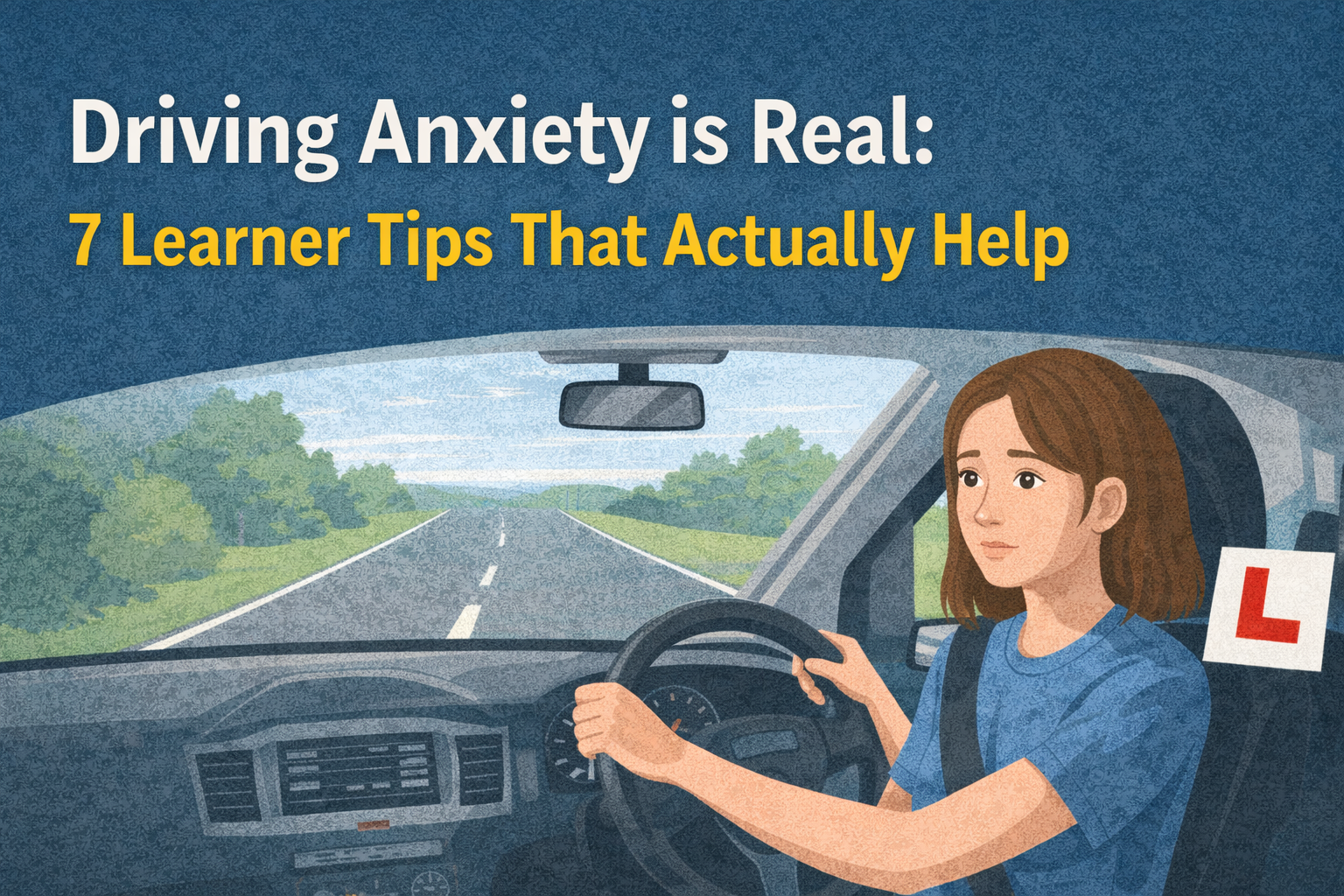
Your palms sweat. Your heart races. You overthink every mirror check. The roundabout ahead feels like a battlefield.
If that sounds familiar, you’re not alone.
Driving anxiety affects thousands of learners across the UK every year. For some, it shows up before lessons. For others, it creeps in right before the practical test. And for many driving learners, it’s the one thing that feels harder to manage than clutch control.
The truth is simple: driving anxiety is real. But it’s also manageable.
Let’s talk about what actually helps not vague advice like “just relax,” but practical strategies that build real confidence behind the wheel.
What Is Driving Anxiety And Why Does It Happen?
Driving anxiety is the fear, nervousness, or panic linked to being behind the wheel. For a driving learner, it can be triggered by:
-
Fear of making mistakes
-
Worry about other drivers judging you
-
Past negative experiences
-
Pressure to pass the driving test
-
Overthinking hazards and scenarios
Learning to drive places you in a fast-moving environment where decisions matter. That responsibility can feel heavy at first. Your brain is trying to protect you, it simply hasn’t learned yet that you’re capable. The key is teaching it that you are.
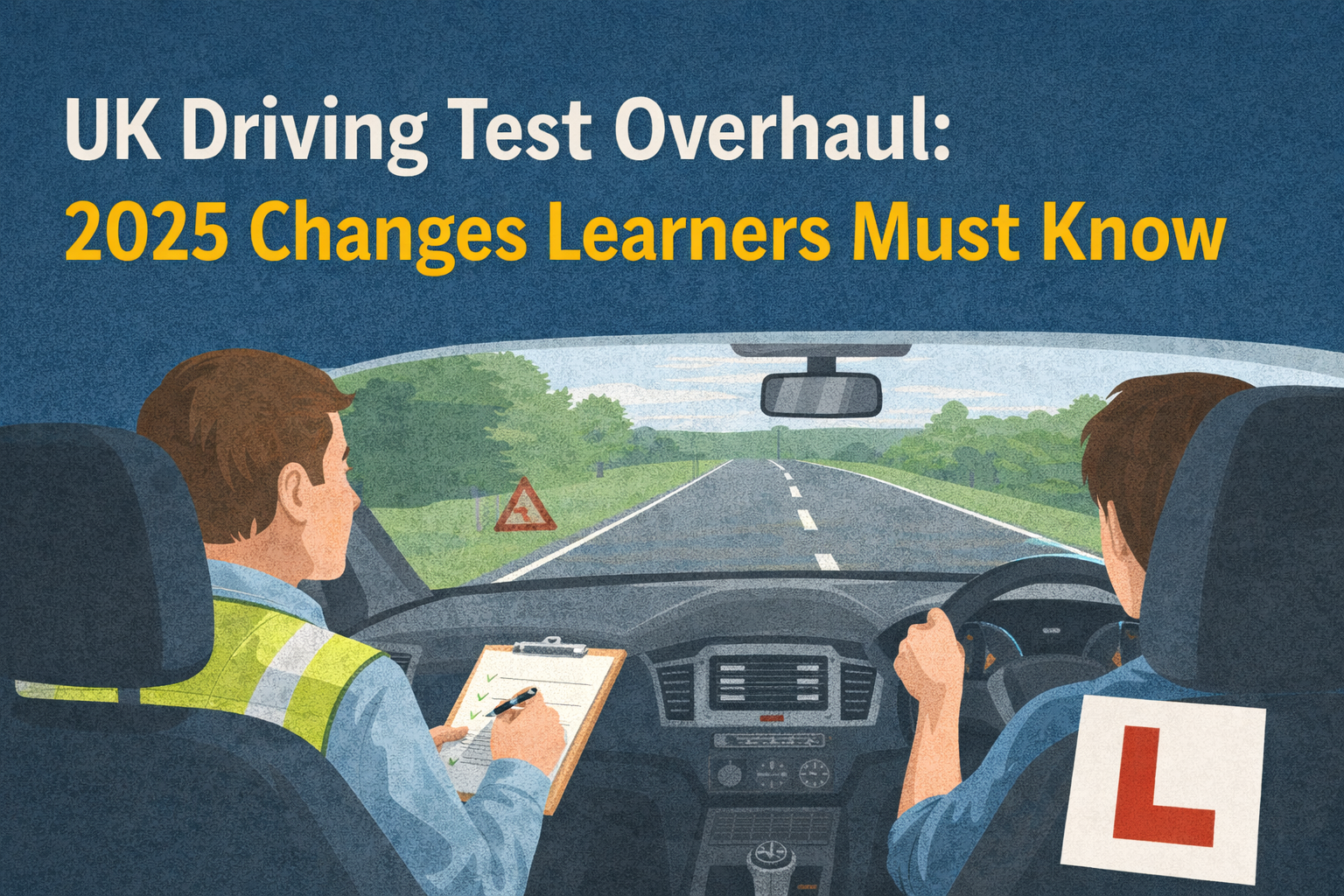
If you want a clear breakdown of the latest rule updates, read our guide on “UK Driving Test Overhaul: What Learners Need to Know About the New Changes” to see how the new format could affect your preparation.
1. Accept That Nerves Are Normal
The first mistake many driving learners make is thinking they shouldn’t feel anxious.
You’re controlling a vehicle on public roads. Of course there are nerves.
Instead of fighting driving anxiety, acknowledge it. Say to yourself:
“I’m nervous because this matters to me.”
That small mindset shift removes shame from the equation. And once shame is gone, improvement becomes easier.
Even experienced drivers felt this way once. The difference is repetition turned fear into familiarity.
2. Break the Lesson Into Micro-Goals
One major cause of driving anxiety is overwhelm.
Instead of thinking:
“I have to drive perfectly for an hour,”
Shift to:
“For the next five minutes, I’ll focus on smooth steering.”
When you break lessons into smaller tasks, your brain processes less pressure. This technique is especially effective for any driving learner who feels flooded with instructions.
Focus on one thing at a time:
-
Mirror checks
-
Smooth braking
-
Lane position
-
Speed awareness
Stack small wins. Confidence builds quietly.
3. Practice Controlled Breathing Before You Start the Engine
Anxiety is physical before it’s mental. Your breathing becomes shallow, which tells your brain something is wrong.
Try this before your lesson begins:
-
Inhale slowly for 4 seconds
-
Hold for 4 seconds
-
Exhale for 6 seconds
Repeat 4–5 times.
This calms your nervous system and reduces driving anxiety before you even move. Many learners notice their hands feel steadier immediately.
This technique works brilliantly before a mock test or the real practical exam.
4. Reframe Mistakes as Training Data
One of the biggest triggers for driving anxiety is the fear of messing up.
Stalled at a junction?
Missed a mirror check?
Took a turn too wide?
That’s not failure. That’s feedback.
Every confident driver you see today once stalled, misjudged a roundabout, or forgot a signal. The difference is they didn’t quit.
A driving learner improves faster when mistakes are treated as part of the process not proof of inability.
Your instructor expects errors. That’s literally why lessons exist.
5. Practice Outside Your Comfort Zone (Gradually)
Avoidance feeds driving anxiety.
If roundabouts scare you and you avoid them, your brain learns: “Roundabouts are dangerous.”
Instead, try gradual exposure:
-
Start with mini roundabouts
-
Move to quiet dual carriageways
-
Then try busier ones during off-peak hours
Each exposure teaches your brain that you survived and handled it.
Confidence doesn’t arrive before action. It arrives after repetition.
6. Limit “Horror Story” Input
Every driving learner knows someone who failed three times. Or heard stories about strict examiners. Or watched dramatic driving test fail videos online.
Constant exposure to negative stories amplifies driving anxiety.
Instead, feed your brain better data:
-
Watch successful mock tests
-
Read positive learner experiences
-
Focus on preparation instead of pass rates
Your mind believes what you repeatedly show it. Choose inputs wisely.
7. Simulate Test Conditions Before Test Day
Much of driving anxiety spikes during the practical test because it feels unfamiliar.
The solution? Make it familiar.
Ask your instructor to run full mock tests with minimal guidance. No prompts. No casual conversation. Just real-test conditions.
The first one might feel intense. The second becomes manageable. By the third, it feels structured rather than scary.
When the real test arrives, your brain recognises the pattern. And familiarity reduces fear.
Why Driving Anxiety Doesn’t Mean You’ll Fail
Here’s something important: nervous drivers often make safer drivers.
Why?
Because they pay attention.
A driving learner who experiences driving anxiety is usually more aware of surroundings, speed, and hazards. The key is channeling that awareness without letting panic take over.
Examiners don’t expect perfection. They assess safety, observation, and decision-making.
You’re allowed to take a breath before moving off. You’re allowed to pause and reassess.
You’re not being judged, you’re being evaluated for readiness.
Big difference.
When Anxiety Becomes Overwhelming
If your driving anxiety causes:
-
Panic attacks
-
Tears before every lesson
-
Avoidance of booking tests
-
Sleepless nights
It may be worth speaking openly with your instructor. A supportive instructor can adjust pacing, route difficulty, and teaching style.
In some cases, short-term support from a GP or therapist can also help if anxiety extends beyond driving. There’s no weakness in asking for support. Driving is a skill and like any skill, mindset matters.
The Confidence Curve Every Learner Goes Through
Most driving learners follow this emotional pattern:
-
Excited to start
-
Slightly overwhelmed
-
Frustrated by mistakes
-
Small improvements appear
-
Confidence grows
-
Test nerves spike
-
Relief and pride after passing
If you’re somewhere between stages 2 and 4, you’re exactly where you should be. Driving anxiety often peaks right before competence clicks into place. Keep going.
Practical Confidence Boosters You Can Start Today
Here are quick, realistic actions that help immediately:
-
Arrive 10 minutes early so you’re not rushed
-
Adjust your seat and mirrors calmly before starting
-
Visualise completing a smooth junction before reaching it
-
Speak actions quietly to yourself (“Mirror, signal, slow”)
-
Celebrate progress after each lesson
Small rituals reduce uncertainty. Less uncertainty means less anxiety.
The Bigger Picture: You’re Learning Independence
Learning to drive isn’t just about passing a test.
It’s about independence. Job opportunities. Visiting family. Late-night food runs. Freedom.
Driving anxiety feels powerful in the moment, but it’s temporary. The licence you earn lasts for years.
When fear feels loud, remember what you’re building. Confidence isn’t the absence of nerves. It’s moving forward despite them.
Conclusion: Driving Anxiety Is Temporary, Skill Is Permanent
Driving anxiety is real. It’s common. And it doesn’t mean you’re not capable.
With structured practice, gradual exposure, supportive instruction, and the right mental tools, any driving learner can move from anxious to assured.
The goal isn’t to eliminate nerves completely. The goal is to manage them well enough to drive safely and confidently. And that’s something you absolutely can do with Road Skills.